Where We Are
Working project snapshot for advisor conversations. Status values are planning estimates and can be updated as committee feedback is received.
Scope now centers on the secondary → postsecondary bridge and early postsecondary access.
Needs assessment: self-knowledge, self-advocacy, disclosure, navigation, responsibility transfer, continuity.
Resource map and residual gap analysis; emerging core concept: Access Continuity.
Applied bridge response plus a bounded web/app demonstration derived from Papers 1 and 2.
Research-to-Practice Architecture
Needs
Paper 1 identifies what students and systems need.
Gaps
Paper 2 tests what already exists and where continuity breaks.
Design
Paper 3 translates verified gaps into a bounded framework.
Practice
Prototype + EDIS practitioner translation.
Timeline
- Fall 2026 · FYC 6901
Committee setup, proposal review/defense, Paper 1 & 2 refinement, begin Paper 3 and prototype.
- Nov–Dec 2026
Cross-paper citation alignment, publication refinement, prototype documentation.
- Spring 2027 · FYC 6912
Complete project, schedule defense before Graduate School deadline, notify Nicole/Nicci one month prior, final defense and paperwork.
- Beyond UF
Journal submissions and broader policy/implementation study through the Mississippi State EPOD capstone.
Dr. Disruptor Presents the Project
A technology-forward introduction to the research program and the larger vision behind Bridging the Accommodation Gap.
I’m Dr. Disruptor — The Future
Use this video as the personal introduction to the project. It connects the human reason for the work with the research pathway and the emerging student-centered technology solution.
Project pathway: Paper 1 identifies needs → Paper 2 maps resources and gaps → Paper 3 translates evidence into the applied bridge response → Prepare / Bridge / Navigate demonstrates the solution.
Current Work, Drafts, Processes & Ideations
The manuscripts below make up the project package. Cards show a download link once the file has been attached to the site.
Non-Thesis Proposal
Current proposal defining the three-paper architecture, Prepare → Bridge → Navigate prototype, scope, methods, timeline, and academic boundaries.
Open documentPaper 1 — Needs Assessment
Structured review of transition readiness, self-advocacy, navigation, disclosure, transfer of responsibility, and access needs.
Open documentPaper 2 — Resource & Gap Analysis
Original working manuscript mapping resources and testing residual gaps in navigation, implementation, continuity, and technology support.
Open documentPaper 2 — Journal Development Version
Publication-oriented version shaped toward a postsecondary disability journal, with stand-alone framing and stronger practical implications.
Open documentEDIS — From High School to College
Practice-facing translation for families, Extension professionals, youth-serving adults, and emerging adults.
Open documentProject Command Center — DOCX
Earlier committee-facing dashboard/document summarizing where the project is and where it is going.
Open documentProcess / Decision Rules
Ideation Parking Lot
Shared with anyone holding this link
Research Pipeline
One coherent program, with academically distinct outputs.
| Workstream | Question / Function | Current State | Next Scholarly Step | Connection |
|---|---|---|---|---|
Paper 1 Needs assessment | What readiness, self-advocacy, disclosure, navigation, and continuity needs are documented? | Drafted | Verify all study designs; final citation/DOI audit; choose target journal with committee. | Defines the problem before selecting a solution. |
Paper 2 Resource & gap analysis | What already exists, what does it do, and where do meaningful residual gaps remain? | Publication development | Close resource map; strengthen reproducible search trail; formalize Access Continuity concept. | Prevents duplication and justifies Paper 3. |
Paper 3 Applied bridge response | What bounded student-centered functions are justified by verified needs and gaps? | Planned | Turn evidence requirements into product requirements, governance boundaries, and implementation model. | Research → design translation. |
EDIS Practitioner translation | How can families and youth-serving professionals support gradual transfer of agency before college? | Drafted | Final editorial polish and submission pathway. | Turns research into accessible practice guidance. |
MSU EPOD Future doctoral expansion | How do organizations, policy, governance, training, and implementation support or scale the bridge? | Future phase | Preserve UF evidence and design traceability for later policy/system study. | Broadens from student-facing bridge to systems around the bridge. |
Emerging Integrative Concept: Access Continuity
Recognize
Identify what task, environment, or process is creating a barrier.
Articulate + Navigate
Describe the barrier and find the correct human/institutional pathway.
Implement
Move from approval to usable support in the real context.
Review + Adjust
Check whether access remains usable as courses, environments, and needs change.
Applied Hub & Technology Track
The technology is a research-derived demonstration, not the evidence itself.
Prepare — Secondary Education
- Know yourself as a learner
- Strengths, barriers, supports that help
- Practice self-advocacy
- Assistive technology experience
- Questions for prospective colleges
Bridge — Transition / Handoff
- What changes after high school
- IDEA/IEP → postsecondary civil-rights process
- Disclosure/documentation preparation
- Disability-services registration
- Student-controlled access summary
Navigate — Postsecondary
- Accommodation activation/renewal
- Faculty communication preparation
- Course-specific access review
- Escalation preparation
- Verified resources + bounded AI
Bounded AI: Appropriate Roles
- Organize student-entered notes and questions.
- Rewrite complex institutional information in clearer language.
- Help rehearse self-advocacy conversations.
- Navigate to verified resources.
- Create editable process/authorship records where appropriate.
AI: Hard Stops
- No diagnosis or eligibility determination.
- No autonomous accommodation prescription.
- No definitive legal or institutional conclusions.
- No replacing disability services, educators, or student judgment.
- No claims of effectiveness before actual approved evaluation.
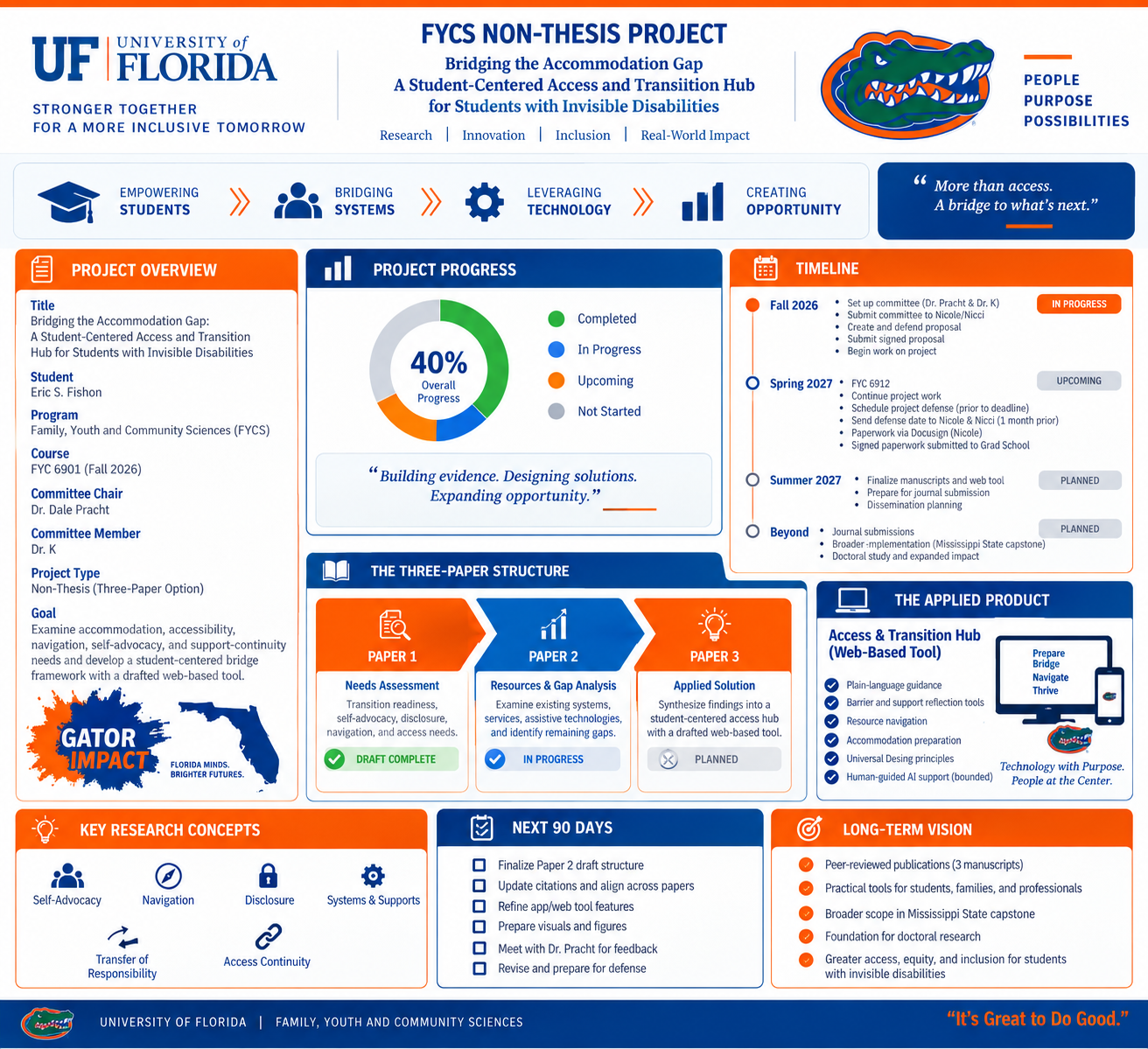
Visual Concept
The earlier orange-and-blue infographic concept is included here as design inspiration. The live dashboard is intentionally more functional and updateable.
Reference Library & Annotated Bibliography
Starter cross-project library drawn from the proposal, Paper 1, Paper 2, and EDIS work. Before submission, verify every entry against the original article/publisher/DOI record and match each reference one-to-one with in-text citations.
| APA-style source | Tags | Annotated use | Best use |
|---|---|---|---|
| Arnett, J. J. (2000). Emerging adulthood: A theory of development from the late teens through the twenties. American Psychologist, 55(5), 469–480. | developmenttransition | Seminal contextual frame for the late-teen/twenties period in which educational, identity, disclosure, and adult-role responsibilities are increasingly negotiated. | Paper 1; EDIS; proposal |
| Blasey, J., Wang, C., & Blasey, R. (2023). Accommodation use and academic outcomes for college students with disabilities. Psychological Reports, 126(4), 1891–1909. | accommodationsimplementation | Supports the distinction between accommodation approval and actual use/outcomes, central to the implementation-continuity gap. | Paper 1; Paper 2 |
| Bronfenbrenner, U., & Morris, P. A. (2006). The bioecological model of human development. In Handbook of child psychology (6th ed.). Wiley. | systemsdevelopment | Provides the systems/context frame: access is produced through interactions among people, relationships, institutions, and time rather than student traits alone. | Paper 1; EDIS; proposal |
| Cho, J. I., & Jones, K. (2024). How do college students with disabilities do? Law, self-determination, self-advocacy, and campus resources. Journal of the Scholarship of Teaching and Learning, 24(3), 68–86. | self-advocacynavigation | Important evidence for uneven disability-law knowledge, self-advocacy, and campus-resource use among college students. | Paper 1; Paper 2; EDIS |
| Coughlan, T., & Iniesto, F. (2025). What should I know? Analysing behaviour and feedback from student use of a virtual assistant to share information about disabilities. The Internet and Higher Education, 66, 101002. | AIvirtual assistant | Demonstrates that conversational technology can sit inside a disability-information process when capability boundaries and institutional integration are explicit. | Paper 2; Paper 3 |
| Cumming, T. M., & Rose, M. C. (2022). Exploring universal design for learning as an accessibility tool in higher education: A review of the current literature. The Australian Educational Researcher, 49(5), 1025–1043. | UDLaccessibility | Supports Universal Design as a cross-cutting accessibility approach rather than a replacement for individualized accommodations. | Paper 2; Paper 3 |
| Edwards, M., Poed, S., Al-Nawab, H., & Penna, O. (2022). Academic accommodations for university students living with disability and the potential of universal design to address their needs. Higher Education, 84(4), 779–799. | accommodationsUDL | Connects accommodation barriers with Universal Design and helps distinguish formal support from usable access. | Paper 1; Paper 2 |
| Hsiao, F., Burgstahler, S., Johnson, T., Nuss, D., & Doherty, M. (2019). Promoting an accessible learning environment for students with disabilities via faculty development. Journal of Postsecondary Education and Disability, 32(1), 91–99. | facultycampus climate | Useful for showing that implementation is also an institutional-capacity problem; disability services cannot be the sole actor responsible for access. | Paper 2; MSU future work |
| Kline, B., & Davidson, D. L. (2022). College students with invisible illnesses and disabilities: Disclosure, hiding, and support. College Student Affairs Journal, 40(3), 121–135. | invisible disabilitydisclosure | Core evidence on hiding, disclosure, and support-seeking for invisible disability in higher education. | Paper 1; Paper 2; EDIS |
| McNicholl, A., Casey, H., Desmond, D., & Gallagher, P. (2021). The impact of assistive technology use for students with disabilities in higher education: A systematic review. Disability and Rehabilitation: Assistive Technology, 16(2), 130–143. | assistive technology | Supports potential academic/psychosocial benefit while reinforcing that technology should be evaluated as part of a broader support ecosystem. | Paper 2; Paper 3 |
| Melián, E., & Meneses, J. (2022). Getting ahead in the online university: Disclosure experiences of students with apparent and hidden disabilities. International Journal of Educational Research, 114, 101991. | disclosureonline learning | Shows disclosure as a contextual process shaped by institutional procedures, stigma, and credibility concerns. | Paper 1; Paper 2 |
| Moore, A. M., Vaccaro, A., Newman, B. M., Daly-Cano, M., & Brandis Ruise, B. (2024). “I shouldn’t have to rely on them anymore”: College students with disabilities on the journey toward self-advocacy. Journal of The First-Year Experience & Students in Transition, 36(1), 93–112. | self-advocacytransition | Important direct-transition evidence that self-advocacy develops as responsibility shifts from family/school supported processes toward student leadership. | Paper 1; EDIS |
| Parsons, J. M., McColl, M. A., Martin, A., & Reynard, D. (2023). Transition and accommodation experiences of students with disabilities: A qualitative study. Journal of Postsecondary Education and Disability, 36(2), 179–192. | transitionaccommodations | Directly relevant qualitative evidence on the more active role students must assume during transition and accommodation navigation. | Paper 1; Paper 2 |
| Pierrès, O., Darvishy, A., & Christen, M. (2025). Exploring the role of generative AI in higher education: Semi-structured interviews with students with disabilities. Education and Information Technologies, 30(7), 8923–8952. | AIstudent voice | Provides disabled-student perspectives on AI benefits, limitations, accuracy, cost, access, policy, and human-support needs. | Paper 2; Paper 3; CUNY AI paper |
| Tufty, L. M., Gallagher, V. T., Oddo, L., Vasko, J., Chronis-Tuscano, A., & Meinzer, M. (2024). Academic accommodations and functioning in college students with ADHD: Limitations, barriers, and suggestions for collaborators. Journal of Postsecondary Education and Disability, 37(1), 35–46. | ADHDimplementation | Condition-specific evidence that accommodation use can remain difficult after approval and may require coordination and adjustment. | Paper 1; Paper 2 |
| Zhao, X., Cox, A., & Chen, X. (2025). The use of generative AI by students with disabilities in higher education. The Internet and Higher Education, 66, 101014. | AIhigher education | Current evidence on real-world GenAI use by disabled students and the accessibility/policy tensions that accompany it. | Paper 2; Paper 3; CUNY AI paper |
Possible Peer-Reviewed Journal Targets
Fit is a planning recommendation, not an acceptance prediction. Journal scope and author instructions were checked against official publisher/journal pages in September 2026; re-check immediately before submission.
Journal of Postsecondary Education and Disability (JPED)
High fitBest candidate for Paper 2 and potentially Paper 1. Strong alignment with postsecondary disability, disability-resource practice, transition, accommodations, and practical implications for disability professionals. Current submission route is through Scholastica.
Journal of Diversity in Higher Education
Selective fitStrong institutional equity/inclusion scope and interest in barriers, access, teaching/learning, policy, and organizational change. Current guidance emphasizes full-length empirical work, so fit may improve if the project later includes stronger empirical/evaluation components.
Disability & Society
Theory / justice fitPotential home if a manuscript is reframed more explicitly through disability studies, disabled voices, human rights, policy/practice critique, inclusion, ableism, or disability justice rather than primarily service-navigation design.
The Internet and Higher Education
AI-focused fitA possible stretch target for a later rigorous AI/accessibility study, especially because current disability-focused virtual-assistant and GenAI research already appears there. More likely for a future empirical/implementation paper than the current non-thesis synthesis.
Next Actions & Advisor Meeting Board
Check items as they are completed. Everything on this board is stored in the project database, so the chair and committee see the same state you do.
Next 30–60 Days
Questions / Decisions for Dr. Pracht
Shared with anyone holding this link
Meeting Notes
Shared with anyone holding this link